BIO 190 - SUPPLEMENTAL BIOLOGY WORKSHOP I
Molecular Genetics
KEY
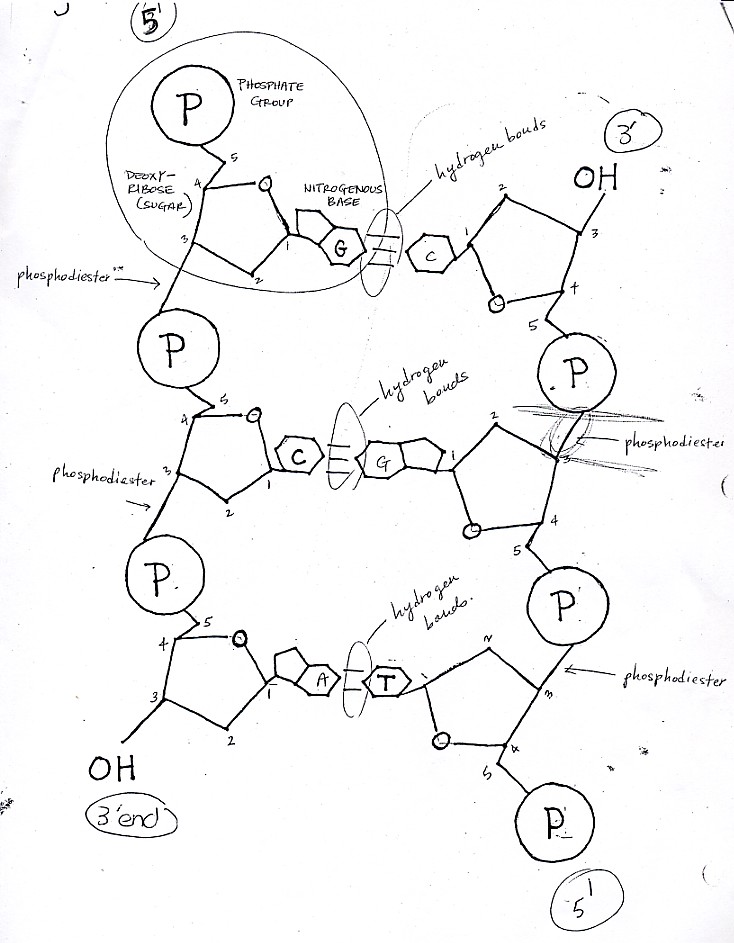
a. Name the basic monomer of DNA biomolecules.
nucleotide
b. Circle one monomer and label its general components.
c. What distinguishes one form of the monomer from another?
nitrogenous base (A, G, C, T)
d. Fill in the missing bases to complete the base pairs.
e. What are the guidelines regarding the pairing of bases between 2 single strtands?
A-T and G-C
f. What type of bond joins the nucleotide components?
phosphodiester
g. Label (by name) the bond that holds together the sugar-phosphate backbone.
covalent
h. Label the hydrogen bonds.
i. The relationship between structure and function is a recurring theme in biology. Describe how the structural positions of covalent and hydrogen bonds in the “double helix” relate to DNA function.
Hydrogen bonds bind the two strands of DNA - these bonds are easily broken - the strands must be separated frequently for replication to occur; Covalent bonds strongly hold together the sugar-phosphate backbone - if broken the DNA would be disrupted
j. Number the carbons on one sugar in each strand.
k. Label the 3’ and the 5’ ends of each strand.
l. Which carbon (by number) binds to the nitrogenous base? The phosphate? The adjoining nucleotide?
1, 5, 3
____.) Which of the following accurately describes DNA structure? (Be sure to justify your answer by explaining the choices that are incorrect.) D
a. DNA molecules are described as antiparallel because each base forms a pair with another base unlike itself.
DNA molecules are described as antiparallel because the sugar-phosphate backbones of the strands run opposite to each other
b. Covalent bonds join 2 strands of nucleotides to form the DNA double helix.
Hydrogen bonds join 2 strands of nucleotides to form the DNA double helix.
c. In a single nucleotide, the number 1 carbon of the deoxyribose attaches to the base, while the number 3 carbon binds to the phosphate.
In a single nucleotide, the number 1 carbon of the deoxyribose attaches to the base, while the number 3 carbon binds to the phosphate of an adjoining nucleotide.
d. If 30% of the bases in a DNA molecule are cytosine, then 20% of the bases must be thymine.
G-C = 30% + 30% = 60%; A-T = 20% + 20% = 40%
____.) Use the figure below, showing the replication of DNA, to answer the following.

a. Label the following items: leading and lagging strands, Okazaki fragment, DNA polymerase, DNA ligase, helicase (the unwinding protein), single-strand binding proteins, RNA primer, replication fork, and 3’ and 5’ ends of all 4 DNA strands.
b. Draw an arrow to indicate the overall direction of replication.
c. Where in the cell does DNA replication occur?
nucleus
d. List, in order, the steps involved in DNA replication. Be sure to include the functions of all the enzymes listed in part a above.
Refer to the appropriate pages in the textbook.
____.)
a. What is the name of the accepted model for DNA replication?
semiconservative
b. After one round of replication, each of the two products should possess how much of the parent strand?
50%
c. If the resulting segments were then replicated, where would the original parent material be found in the four final products?
50% in 2 of the 4 products
d. Draw two rounds of replication from one parent strand of DNA, conforming to the accepted model for DNA replication. Distinguish between the original and the newly formed DNA strands.

e. What measures does the cell take to ensure that the parent and the replicate DNA are exact copies of one another?
DNA polymerase proofreads new DNA to correct mismatches which occurred in replication.
____.) Dr. A.G. Nucleotide, a world renowned geneticist, is studying the effects of varying wavelengths of radiation on DNA radiation. He is treating cultures of E. coli with a specific wavelength of light, and then extracting the DNA to compare it to his control, in which DNA replication always occurs exactly and completely. Described below is the DNA that Dr. Nucleotide extracted from each of his 4 cultures. Determine which enzyme was affected by the radiation in each case.
a. Replication had obviously begun, but each DNA molecule consisted of a normal strand paired with numerous DNA segments each a few hundred nucleotides long.
mutation in DNA ligase
b. The newly synthesized DNA contained many mismatched base pairs.
mutation in DNA polymerase
c. The DNA structure was intact, but there was only half as much DNA in the cell as there should have been.
mutation is helicase
d. The DNA molecules were uncoiled and stabilized, but replication was never initiated.
mutation in RNA primer (primase)
____.) Define transcription. Where in the cell does transcription occur?
the transfer of genetic information from a DNA molecule to mRNA molecules that occurs in the nucleus
____.) Name three main differences between DNA and RNA. Do DNA and RNA use the same language? What is it?
DNA is double-stranded, contains the sugar deoxyribose, and contains the nucleotide thymine whereas RNA is single-stranded, contains the sugar ribose, and contains the nucleotide uracil. DNA and RNA both speak the language - nucleic acids.
____.) List the key steps in transcription, including the roles of RNA polymerase, RNA primer, promoter sequences, the start codon, the sense and antisense strands, and termination codons.
Refer to the appropriate pages and diagrams in the textbook.
____.) Determine whether each of the following statements is true or false. If it is false, then explain what would make it a true statement.
a. For the replication of DNA, 2 primers are needed; one for the leading strand and one for the lagging strand.
False - 1 primer per fragment is needed in the lagging strand
b. DNA polymerase acts to pry the two strands of DNA apart and to hook together nucleotides as they base pair along the DNA template.
False- RNA polymerase acts to pry the two strands of DNA apart and to hook together nucleotides as they base pair along the DNA template.
c. The elongation of the lagging strand during DNA synthesis progresses away from the replication fork.
True
d. The primer required to initiate synthesis of a new DNA strand consists of RNA.
True
e. RNA differs from DNA in that RNA has ribose as its sugar, is only found in the cytoplasm, and contains uracil instead of thymine.
False - mRNA is in the nucleus as well.
f. If a sample of DNA contains 21% thymine, then guanine would also comprise 21% of the total sample.
False - there would also be 21% adenine and therefore 29% each of guanine and cytosine.
g. DNA replication and transcription both occur in a 5’ to 3’ fashion.
True
h. DNA replication occurs in the nucleus and the DNA is then transported to the cytoplasm to be transcribed.
False - transcription occurs in the nucleus.
____.) Define translation. Where in the cell does it occur?
transfer of information from nucleic acid to a polypeptide that occurs at ribosomes
____.) Name the three types of RNA and describe their function.
mRNA - carries genetic message from DNA to cytoplasm
tRNA - transfers amino acids from cytoplasmto ribosome
rRNA - aggregates to form ribosome
____.)
a. Describe how mRNA is modified between transcription and translation. What is this editing process called?
Introns are removed from the mRNA leaving only the exons to be translated.
b. What is this editing process called?
splicing
c. In what part of the cell does it take place?
nucleus
____.) List the steps involved in translation, including the following terms in your description: mRNA, tRNA, codons, anticodons, ribosomes, genetic code, amino acids, and peptide bonds.
Refer to the appropriate pages and diagrams in the textbook.
____.) Which of the following statements accurately describes translation? Justify your answer by explaining the choices that are false. C
a. The sequence of amino acids in a new protein is determined by the sequence of bases that make up the tRNA anticodons.
The sequence of amino acids in a new protein is determined by the sequence of bases that make up the mRNA codons.
b. In order for 64 different codons to translate into 20 amino acids, each codon must code for more than one amino acid.
Each codon codes for only one amino acid, but each amino acid may be coded for by multiple codons.
c. Every polypeptide chain synthesized during translation begins with the amino acid methionine.
Correct
d. The intron pieces of the mRNA are translated by the tRNA molecules into amino acids.
The exons of the mRNA are translated by the tRNA molecules into amino acids.
____.) Identify the following phrases as a description of DNA replication (R), transcription (TR), translation (TL), or any combination of these processes.
a. requires the breaking of hydrogen bonds = R, TR, TL
b. RNA directed synthesis of a polypeptide = TL
c. DNA polymerase replicates nucleotides stands = R
d. occurs in the nucleus = R, TR
e. involves the nitrogenous bases adenine, guanine, and cytosine = R, TR, TL
f. requires unwinding process = R
g. includes introns and exons = R, TR
h. the genetic instructions from DNA are copied into RNA codons = TR
i. requires the formation of peptide bonds = TL
j. creates copies of information in the form of nucleic acids = R, TR
k. occurs in the cytoplasm and the endoplasmic reticulum = TL
l. includes the exons only = TL
m. information is transferred from the nucleotide sequence in DNA to a sequence of amino acids in a polypeptide = TR, TL
n. occurs in a 5’ to 3’ fashion = R, TR, TL
o. requires DNA ligase = R
p. involves a leading and a lagging strand = R
____.) The sense strand of a DNA molecule contains the following sequence of nitrogenous bases.
a. Fill in the nitrogenous bases on the complimentary DNA strand, or the antisense strand.

b. Fill in the nitrogenous bases on the mRNA molecule that result from transcription of the DNA strand.

c. List the codons that comprise this mRNA.
AUG/GCA/UGC/AAG/UAA
d. Which nitrogenous bases represent the start codon?
AUG
e. Which represent the stop codon?
UAA
f. What other codes signal the termination of transcription?
UAG, UGA
g. List the anticodons that characterize the tRNA molecules that will translate the mRNA.
UAC/CGU/ACG/UUC/AUU
h. Using the following figure, list the amino acids coded for by the DNA.

MET-ALA-CYS-LYS
____.) The bacterial genome consists of many operons, discrete clusters of genes that code for the polypeptides that make up a specific protein, often an enzyme. List the 3 primary components of an operon and describe the function of each.
structural genes - code for polypeptides
operator - controls access of RNA polymerase to structural genes
promoter - site where RNA polymerase can bind to DNA and start transcribing structural genes
____.) Use the figure to identify the components of a generic operon. Fill in each blank with one of the following structures: structural genes, operons, RNA polymerase, mRNA, regulatory gene, promoter, and operator.

____.) What molecule is coded for by the regulatory gene?
repressor/activator
____.) An operon can code for an inducible or a repressible enzyme. Describe the difference between the two types.
inducible - enzymes whose synthesis is stimulated by specific small molecules (lac operon)
repressible - synthesis inhibited by a metabolic end product (trp operon)
____.) Refer to the figure to answer the following questions about lac operon:

a. How many structural genes comprise this operon?
3
b. Does this operon code for an inducible or a repressible enzyme?
inducible
c. What reaction does the enzyme catalyze?
catabolism of lactose
d. The concentration of what molecule regulates the expression of the lac operon genes?
allolactose (isomer of lactose)
e. In figure a, do you think there is a high or low concentration of this molecule?
How can you tell?
low because if the small molecule were bound, the repressor wouldn't be on (the repressor is active and bound to the operator)
f. Is the repressor in the active or inactive state?
active
g. Are the structural genes being expressed? (In other words, is the operon ON?) How can you tell?
No because the repressor is bound to the operator, blocking RNA polymerase from transcribing
h. In figure b, do you think there is high or low concentration of the molecule that regulates expression?
high
i. Is the repressor in the active or inactive state?
inactive
j. Are the structural genes being expressed?
Yes
____.) Refer to the following figure to answer the following questions about the trp operon:

a. How many structural genes comprise this operon?
5
b. Does this operon code for an inducible or a repressible enzyme?
repressible
c. What reaction does the enzyme catalyze?
synthesis of trp
d. The concentration of what molecule regulates the expression of the trp operon genes?
trp
e. In figure a, do you think there is a high or low concentration of this molecule? How can you tell?
low because operator is on, not bound to repressor
f. Is the repressor in the active or inactive state?
inactive
g. Are the structural genes being expressed? How can you tell?
Yes because the repressor is inactive and so it is not able to bind to operator and thus, transcription can proceed
h. In figure b, do you think there is high or low concentration of the molecule that regulates expression?
high
i. Is the repressor in the active or inactive state?
active
j. Are the structural genes being expressed?
No
____.) A particular operon produces enzymes that manufacture an important amino acid. If this process works as it does in other operons, D
a. the amino acid inactivates the repressor
b. the enzymes produced are called inducible enzymes
c. the repressor binds to the operator in the absence of the amino acid
d. the amino acid “turns off” enzyme synthesis
____.) A mutation that renders the regulatory gene of a repressible operon nonfunctional would result in: C
a. irreversible binding of the repressor to the promoter
b. accumulation of large quantities of a substrate for the catabolic pathway controlled by
the operon.
c. continuous transcription of the structural genes
d. excessive production of the repressor molecule
____.) Identify each of the following phrases as a description of prokaryotes (P), and eukaryotes (E), or both.
a. transcription and translation are spatially and temporally separated = E
b. transcription and translation of a single strand of mRNA occur simultaneously = P
c. mRNA is spliced prior to translation = E
d. DNA replication occurs at more than one replication fork to speed up the copying of the circular genome = P
e. genes are turned on and off in response to signals from the environment = BOTH
f. genes are expressed in discrete clusters called operons = P
g. DNA replication occurs in the nucleus = E
h. mutation is a source of genetic variation = BOTH
____.)
a. Define recombination.
combining of genetic material from 2 individuals into the genome of a single individual
b. Name at least 2 ways in which eukaryotic organisms recombine genetic material.
crossing over (meiosis), fertilization
c. How does bacterial reproduction differ from eukaryotic reproduction?
no meiosis or fertilizationin prokaryotes
____.) Name at least 4 ways in which bacteria can incorporate new genetic material into their genome.
mutation, conjugation, transposition, transformation, transduction
____.) Identify the type of bacterial genetic transfer described in each of the following cases:
a. Phage DNA coding for chemical digestion is incorporated into the bacterial genome = transduction
b. A bacterium engulfs free DNA from the environment, which may then be incorporated into
the genome and expressed = transformation
c. A gene moves from one site to another in the genome, potentially, disrupting another gene’s expression = transposition
d. A bacterium with an F+ factor transfers genetic material to another bacterium = conjugation
____.) What is the significance of recombination in both prokaryotes and eukaryotes?
generates genetic variability - diversity, variable fitness
____.) Define mutation.
change in genetic makeup of a cell
____.) ______Mutagens_______ are physical and chemical agents that interact with DNA to cause mutations. Name at least 3 examples.
UV light, radiation, chemicals
____.) Identify each of the following as a description of a silent, nonsense, missense, insertion, or deletion type of mutation. Some may describe more than one type. Use the genetic code chart below.
a. changes reading frame of genetic message = frameshift
b. GAACAAUUA mutates to GAACACUUA = missense
c. due to the redundancy in the genetic code, there is no effect on the protein product = silent
d. GCAUACUAA mutates to GCAUAGUAA = nonsense
e. GAUCCUUUG mutates to GAUCCUCUG = silent
f. alterations that change an amino acid codon to a stop signal = nonsense
g. a mutated codon codes for an amino acid and this still makes sense, although not necessarily the right sense = missense
h. GGACUAAUC mutates to GGAACUAAUC = insertion
i. UAUCGGCAA mutates to UAUCGGCAC = missense
© 2002-2003 Kevin Hong